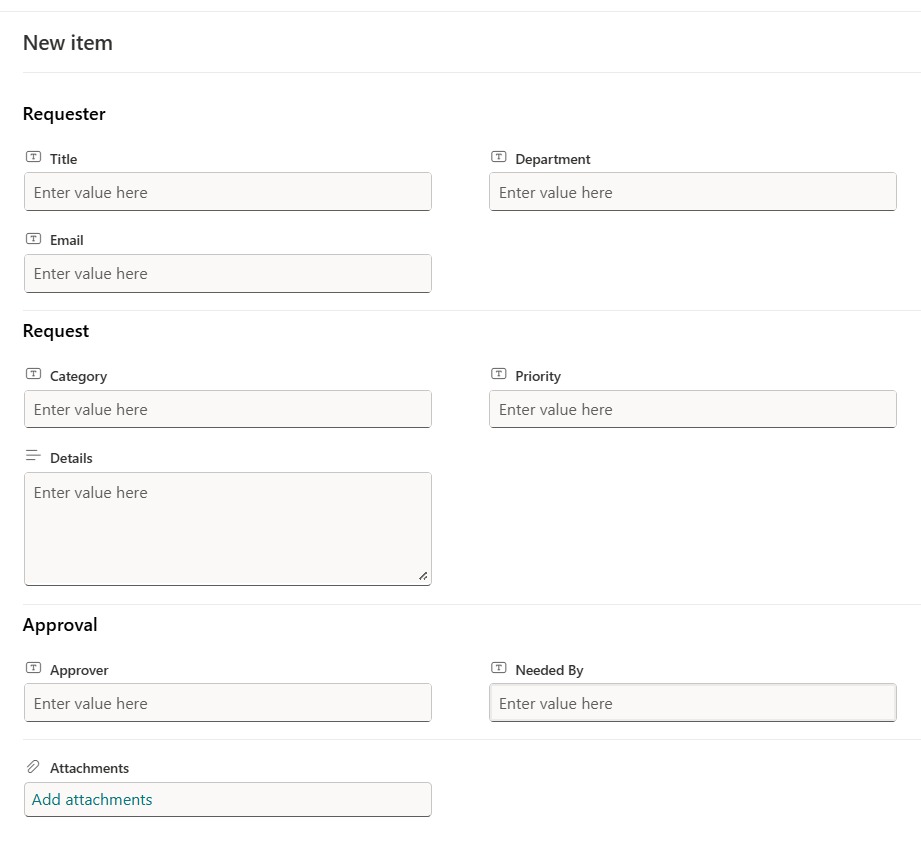
Grouped Sections (Form JSON)


Overview
- Divides the form’s fields into labeled sections
- Each section groups related fields under a clear heading
- Makes long forms much easier to read and fill in
- Any field not placed in a section is added to the last one automatically
- Applied as form-configuration JSON in the body, so it changes nothing about the data
- Works on any list form, and the sections are easy to arrange
Common Use Cases
- Long request or intake forms
- Onboarding forms
- Project or case forms
- Application forms
- Procurement requests
- Any form with many fields
Details
- Design Pattern: Form Design
- Format Scope: Form
Required Columns
| Display name | Column type | Internal name |
|---|---|---|
| Title | Single line of text | [Title] |
| Department | Single line of text | [Department] |
| Single line of text | [Email] | |
| Category | Single line of text | [Category] |
| Priority | Single line of text | [Priority] |
| Details | Multiple lines of text | [Details] |
| Approver | Single line of text | [Approver] |
| Needed By | Single line of text | [Needed By] |
How to Apply JSON code
- Open the list, then open any item to show its form.
- At the top of the form, expand the Edit form (pencil) icon and choose Configure layout.
- In the Apply formatting to dropdown, choose Body.
- Paste the JSON below into the box, preview, and click Save.
JSON Code
{
  "sections": [
    {
      "displayname": "Requester",
      "fields": [
        "Title",
        "Department",
        "Email"
      ]
    },
    {
      "displayname": "Request",
      "fields": [
        "Category",
        "Priority",
        "Details"
      ]
    },
    {
      "displayname": "Approval",
      "fields": [
        "Approver",
        "Needed By"
      ]
    }
  ]
}Common Questions About Grouped Sections
What is Grouped Sections built with?
It is built with a standard Microsoft List (SharePoint list) and form-configuration JSON applied to the form body. There is no custom development, no SPFx solution, and no third-party tools. It is the kind of clean, maintainable formatting Greg Zelfond builds for teams that want organized forms without ongoing development overhead.
How do the sections work?
In the body configuration you define one or more sections, each with a heading and a list of fields. SharePoint then lays the form out by those sections, and any field you do not place is automatically added to the last section.
Does this design use any custom development or third-party tools?
No. It uses only out-of-the-box SharePoint form configuration, which Microsoft supports natively. That keeps it stable and easy to maintain, and nothing breaks when SharePoint is updated. Out-of-the-box is the only way Greg builds, so you can own and extend the design yourself for years.
If LookBook 365 is code-free and out-of-the-box, why does this example include JSON?
Because SharePoint formatting JSON is not custom code – it is a native configuration feature built into lists and libraries. It is declarative: it only describes how an existing form looks, and cannot run scripts, reach external services, or change your data. Nothing is deployed and nothing breaks when Microsoft updates SharePoint, and you can edit or remove it anytime. That is why LookBook 365 treats it as out-of-the-box and low risk.
Will it change to a multi-column layout?
Configuring the body switches the form to SharePoint’s section layout, which arranges the sections you define. The fields and their data stay the same – you are only grouping them under headings.
Can Greg build form formatting like this for our team?
Yes – this is exactly the kind of work Greg Zelfond does. As an independent SharePoint consultant and Microsoft MVP, he designs out-of-the-box list and library form formatting like this so your team can read and maintain it without a developer. Reach out through the contact page to talk about your forms.