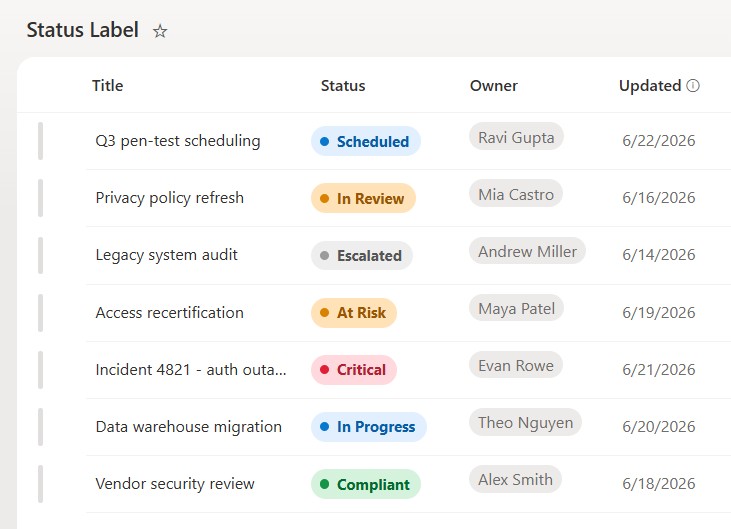
Status Label


Overview
- Renders any status or choice value as a colored pill, so the whole column reads at a glance
- A leading dot and a tinted background share one semantic color – green for good, amber for caution, red for problems, blue for in-progress
- Unmapped or blank values fall back to a neutral gray pill labeled Not set, so the column never looks broken
- One reusable pattern covers risk levels, severities, compliance states, and alert statuses
- Uses the current column, so the same JSON drops onto any choice field without renaming anything
- Applied as column-formatting JSON, so it travels with the view and changes nothing about the underlying data
Common Use Cases
- Risk register status such as On Track, At Risk, and Critical
- Incident severity or priority levels
- Compliance state such as Compliant, In Review, and Non-Compliant
- Alert and monitoring status
- Approval or review workflow stages
- Vendor, project, or service health
Details
- Design Pattern: Status & Indicator Badges
- Format Scope: Column
Required Columns
| Display name | Column type | Internal name |
|---|---|---|
| Title | Single line of text | [Title] |
| Status | Choice | [Status] |
| Owner | Person or Group | [Owner] |
| Updated | Date and time | [Updated] |
Prerequisites
- Build a list with these columns before you paste the JSON.
- Populate the list with data.
- Because the JSON is applied at the column level, the Status column can use any name you want.
- It matches values by exact text, so edit the value lists inside the JSON to fit your own choices; anything it does not recognize shows a neutral Not set pill.
How to Apply JSON code
- On the Status column, open the column header menu, choose Column settings, then Format this column.
- Switch to Advanced mode.
- Paste the JSON below and click Save.
JSON Code
{
  "$schema": "https://developer.microsoft.com/json-schemas/sp/v2/column-formatting.schema.json",
  "elmType": "div",
  "style": {
    "display": "flex",
    "align-items": "center",
    "justify-content": "flex-start",
    "height": "100%",
    "width": "100%"
  },
  "children": [
    {
      "elmType": "div",
      "style": {
        "display": "inline-flex",
        "align-items": "center",
        "box-sizing": "border-box",
        "max-width": "100%",
        "height": "26px",
        "padding": "2px 10px 2px 8px",
        "margin": "3px 0",
        "border-radius": "13px",
        "background-color": "=if((@currentField == 'On Track' || @currentField == 'Approved' || @currentField == 'Compliant' || @currentField == 'Resolved' || @currentField == 'Healthy'), '#d5f2dc', if((@currentField == 'At Risk' || @currentField == 'In Review' || @currentField == 'Pending' || @currentField == 'Monitoring'), '#ffe2b8', if((@currentField == 'Critical' || @currentField == 'Blocked' || @currentField == 'Non-Compliant' || @currentField == 'Overdue'), '#ffd9dd', if((@currentField == 'In Progress' || @currentField == 'New' || @currentField == 'Open' || @currentField == 'Scheduled'), '#e1efff', '#eeeeee'))))"
      },
      "children": [
        {
          "elmType": "div",
          "style": {
            "width": "8px",
            "height": "8px",
            "border-radius": "50%",
            "margin-right": "7px",
            "flex-shrink": "0",
            "background-color": "=if((@currentField == 'On Track' || @currentField == 'Approved' || @currentField == 'Compliant' || @currentField == 'Resolved' || @currentField == 'Healthy'), '#159447', if((@currentField == 'At Risk' || @currentField == 'In Review' || @currentField == 'Pending' || @currentField == 'Monitoring'), '#d98200', if((@currentField == 'Critical' || @currentField == 'Blocked' || @currentField == 'Non-Compliant' || @currentField == 'Overdue'), '#e01e37', if((@currentField == 'In Progress' || @currentField == 'New' || @currentField == 'Open' || @currentField == 'Scheduled'), '#0878cf', '#9b9b9b'))))"
          }
        },
        {
          "elmType": "span",
          "style": {
            "font-size": "13px",
            "font-weight": "700",
            "line-height": "20px",
            "white-space": "nowrap",
            "overflow": "hidden",
            "text-overflow": "ellipsis",
            "color": "=if((@currentField == 'On Track' || @currentField == 'Approved' || @currentField == 'Compliant' || @currentField == 'Resolved' || @currentField == 'Healthy'), '#006b2b', if((@currentField == 'At Risk' || @currentField == 'In Review' || @currentField == 'Pending' || @currentField == 'Monitoring'), '#9a5600', if((@currentField == 'Critical' || @currentField == 'Blocked' || @currentField == 'Non-Compliant' || @currentField == 'Overdue'), '#b21f32', if((@currentField == 'In Progress' || @currentField == 'New' || @currentField == 'Open' || @currentField == 'Scheduled'), '#075da8', '#555555'))))"
          },
          "txtContent": "=if(@currentField == '', 'Not set', @currentField)"
        }
      ]
    }
  ]
}
Common Questions About the Status Label
What is the Status Label built with?
It is built with a standard Microsoft List (SharePoint list) and a small piece of column-formatting JSON. There is no custom development, no SPFx solution, and no third-party tools. It is the kind of clean, maintainable formatting Greg Zelfond builds for teams that want a status column to read at a glance without ongoing development overhead.
What kind of column does it need?
It needs one Choice column (a single line of text column also works) that stores a status value such as On Track, At Risk, or Critical. The JSON reads the current column rather than a fixed name, so it works on any status field, and it matches each value by its exact text.
Does this design use any custom development or third-party tools?
No. It uses only out-of-the-box SharePoint column formatting, which Microsoft supports natively. That keeps it stable and easy to maintain, and nothing breaks when SharePoint is updated. Out-of-the-box is the only way Greg builds, so you can own and extend the design yourself for years.
If LookBook 365 is code-free and out-of-the-box, why does this example include JSON?
Because SharePoint formatting JSON is not custom code – it is a native configuration feature built into lists and libraries. It is declarative: it only describes how an existing column looks, and cannot run scripts, reach external services, or change your data. Nothing is deployed and nothing breaks when Microsoft updates SharePoint, and you can edit or remove it anytime. That is why LookBook 365 treats it as out-of-the-box and low risk.
Can it use my own status values and colors?
Yes. The values are grouped into color buckets inside the JSON, so you edit those short lists to match your own choices and adjust the colors to your brand. Any value you do not map falls back to a neutral Not set pill, so the column stays tidy even before every value is covered.
Can Greg build status pills like this for our lists?
Yes – this is exactly the kind of work Greg Zelfond does. As an independent SharePoint consultant and Microsoft MVP, he designs out-of-the-box list and library formatting like this so your team can read and maintain it without a developer. Reach out through the contact page to talk about your lists.