Budget Variance Percentage (Formula)
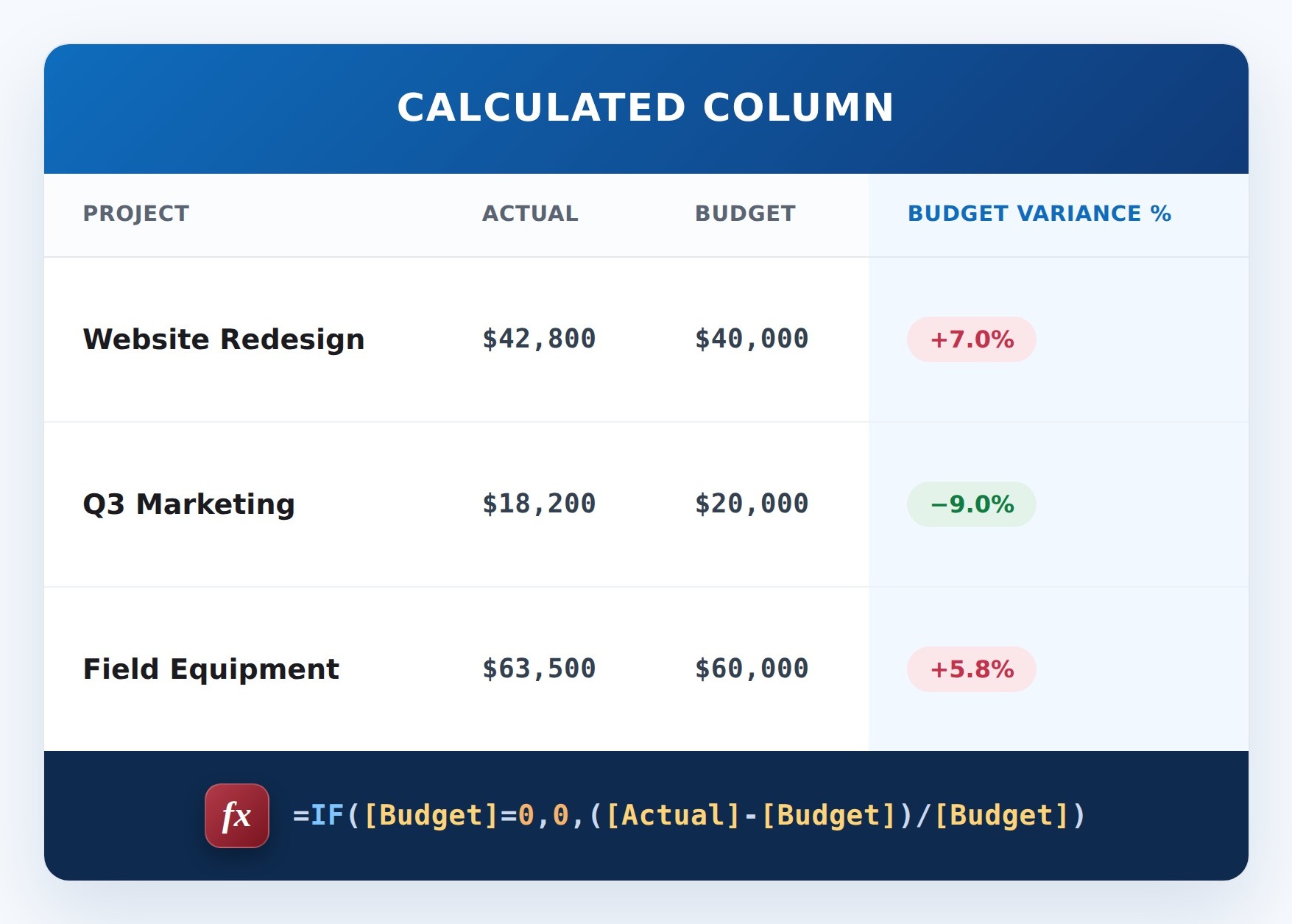
This calculated column uses a SharePoint formula to over/under as a %. Because it lives in a calculated column, SharePoint fills the value in for every item automatically - no custom development and nothing for your users to type.


How It Works
- What it does: Shows the gap between Actual and Budget as a percentage of Budget.
- What you get: A percentage – Actual 1,200 against Budget 1,000 shows 0.2 (20% over). A Budget of 0 returns 0 instead of an error.
- If a value is missing: If Actual or Budget is blank, you get a blank or an error, not a percentage. Calculated columns only display a value.
Common Use Cases
- Percentage over or under budget
- Cost-control dashboards
- Variance thresholds
- Financial reporting
- Grant and project spend tracking
- Departmental budget reviews
Details
- Formula Type: Calculated Column
- Formula Category: Numbers & Money
Required Columns
| Display name | Column type |
|---|---|
| Actual | Currency |
| Budget | Currency |
| Budget Variance Percentage | Calculated |
Prerequisites
- Create the two Currency columns the formula reads: Actual and Budget
- Add or edit a few items so there is data for the formula to calculate
How to Apply the Formula
- Add a column, choose More…, then select Calculated (calculation based on other columns)
- Set the data type returned from this formula to Number
- Paste the formula below into the Formula box
- Click OK to create the column
Formula
=IF([Budget]=0,0,([Actual]-[Budget])/[Budget])Common Questions About Budget Variance Percentage Formula
What does this formula do?
Over/under as a %. It lives in a calculated column, so SharePoint fills the value in automatically for every item.
Which columns do I need to set this up?
You need: Actual (Currency), Budget (Currency). The formula reads these to produce its result.
Can I change the formula for my own columns?
Yes. Swap the column names in brackets for your own, and adjust any numbers or text.
If LookBook 365 is code-free and out-of-the-box, why does this example use a formula?
A SharePoint formula is native, declarative configuration, not custom development. It only works with the item’s own fields and simple logic – it cannot run scripts, reach external services, or change other data, and nothing is deployed to your tenant. It keeps working through Microsoft updates. If you would rather not set this up yourself, this is exactly the kind of thing I configure for clients.
Budget Variance Percentage Formula Example