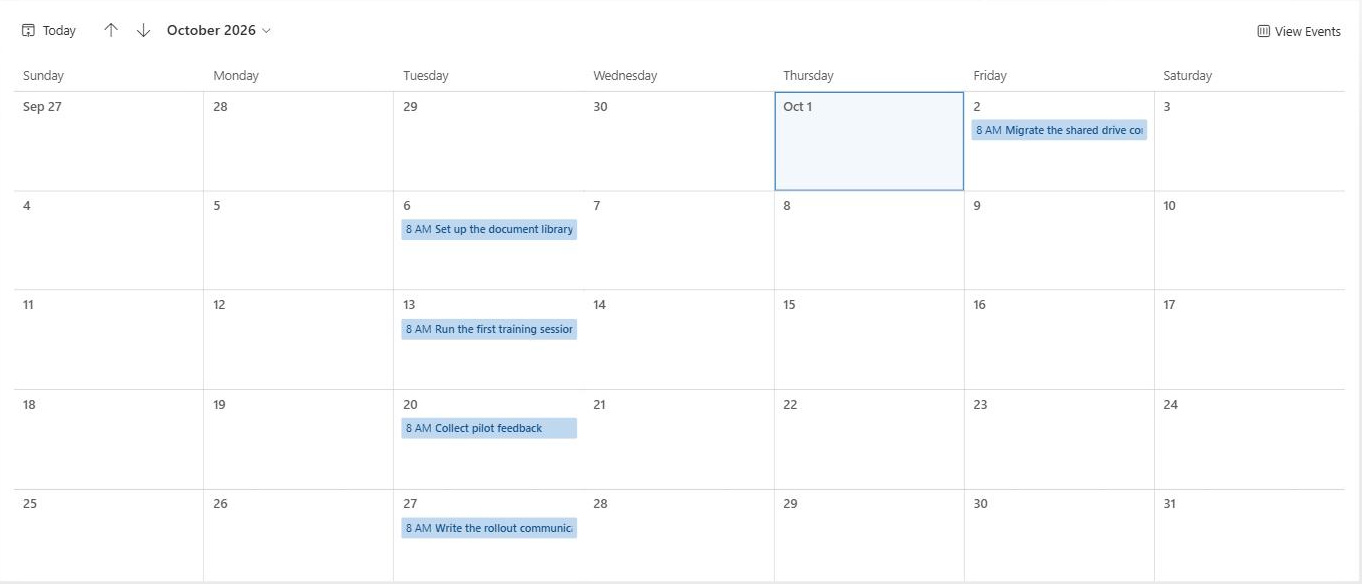
Calendar View
Common Use Cases
- Team event calendars: track department events, training sessions, and meetings on a shared monthly grid
- Deadline tracking: plot project milestones and due dates so the whole team sees what lands when
- Vacation and absence boards: display time-off requests across a date range so managers spot coverage gaps
- Content calendars: schedule news posts, campaigns, and publication dates for communications teams
- Room and resource planning: visualize bookings and reservations stored in an ordinary list
- Multi-day activities: show conferences, audits, or rollouts that span several days as continuous bars
Benefits
- Instant visual context: dates in rows are abstract, while the same items on a grid are immediately understandable
- No separate calendar app: the schedule lives in the same list as the rest of your data, with nothing extra to sync
- Multiple lenses on one list: the calendar is just another view, so the same items can appear as list, board, or gallery too
- Easy item creation: new items can be added directly from the calendar with their dates prefilled
- Works in lists and libraries: documents with date metadata can be plotted just like events
- Familiar layouts: monthly and weekly arrangements mirror the calendar tools people already use every day
Details
- Feature Category: Columns & Views
How It Works
- Date columns drive placement: the view plots each item using the start, and optional end, date and time columns you choose
- Single or multi-day events: give an item both a start and end date and it stretches across every day in its range as a bar
- Pick what each item shows: choose which column, usually the title, appears as the label so events read clearly on the grid
- Just another view of the list: the calendar is a saved view definition, so the underlying items stay ordinary list items
- Open straight to the schedule: set the calendar as the default view so the list lands on the calendar instead of rows
- Add events in context: create new items directly from the calendar with their dates already filled in
Limits and Nuances
- Date and time columns required: the start and end dates must be actual date and time columns on the list
- Calculated columns are not supported: a calculated column cannot serve as the start or end date, even when its formula returns a date
- Items without dates do not appear: any item missing a value in the selected date column is absent from the grid
- View threshold applies: the calendar is still a list view, so the 5,000-item List View Threshold governs what a query can return
- Format is fixed at creation: an existing list view cannot be converted to a calendar; you create a new view in the calendar format
- Recurring events are individual items: a modern list calendar shows each occurrence as its own item, so true repeating meetings are better kept in Outlook or a Microsoft 365 group calendar
Common Questions About the Calendar View
What do I need to create a calendar view in SharePoint?
You need a list or library with at least one date and time column. When you create the view, you choose calendar as the format, select the start date column, and optionally an end date column so items can stretch across several days. Existing lists work fine, which means you can add a calendar lens to data you already have without rebuilding anything.
Can a calendar view show items that span multiple days?
Yes. When you select both a start date column and an end date column, an item stretches across every day in its range, so a three-day conference appears as a continuous bar. Both columns must be date and time columns on the list. Items with only a start date appear on that single day instead, which is usually what you want for one-off events.
Why are some items missing from my calendar view?
The most common reason is an empty date column: items without a value in the selected start date column have no place on the grid. View filters also apply, so a filtered calendar hides items just like any other view. Finally, the calendar is still a list view, which means the 5,000-item List View Threshold governs what a query can return at once.
Does the calendar view support recurring events?
Items in a modern list calendar view are individual list items, so a weekly meeting is represented by separate items for each occurrence. Many teams keep true recurring meetings in Outlook and Microsoft 365 group calendars, and use list calendar views for deadlines, schedules, and date-driven tracking where each entry is a distinct item.
Can I use a calculated column for the calendar dates?
No. Calculated columns are not supported as the start or end date of a calendar view, even when the formula returns a date and time result. The standard approach is to add a real date and time column and populate it automatically, for example with a simple Power Automate flow, so the calendar always has a true date to plot each item against.
Who can build a polished calendar solution for my intranet?
Calendar views work out of the box, but a great scheduling experience also involves the right columns, sensible views for different audiences, and pages that surface the calendar where people work. Greg Zelfond, the SharePoint consultant behind LookBook 365, designs and builds these solutions using only out-of-the-box SharePoint, so they stay simple to own and maintain.